Syed Saad Ali

Oracle ACE Pro

Oracle Solution Architect

Oracle E-Business Suite

Oracle Cloud Infrastructure

Oracle Fusion Middleware

Oracle Database Administration

Oracle Weblogic Administration

Syed Saad Ali

Oracle ACE Pro

Oracle Solution Architect

Oracle E-Business Suite

Oracle Cloud Infrastructure

Oracle Fusion Middleware

Oracle Database Administration

Oracle Weblogic Administration

Home

About Me

Technically-sophisticated professional with extensive experience in updating server security, executing routine back-ups, and designing and implementing tests of the system to address issues with accessing data

  • Adept at leading the planning, designing, developing, testing, and deploying efficient solutions within Oracle EBS system, in order to satisfy strategic, financial, and operations needs of the organization.
  • Skilled in planning and managing successful projects, mitigating risks, controlling costs, and directing project teams. Instrumental in monitoring routine maintenance of system, implementing the ERP systems, and approving budget.
  • Proven success in analyzing business processes/process re-engineering and recommending solutions. Deft at establishing IT service continuity management strategies, disaster recovery plans and associated test procedures of each critical functional area of the organization.
  • Age: 37
  • Residence: Pakistan
  • Freelance: Available
  • Address: Karachi, PAKISTAN
My Services
Oracle E-Business Suite Upgrade
Oracle E-Business Suite Migration
Oracle Database Upgrade or Migrate
Oracle Maximum Availability Architecture
Performance Evaluation
Pricing
Hire Me On Upwork
$ 35 Hour
  • Database Administration
  • Oracle E-Business Suite Administration
  • Configuration, Administration, Cloning, Patching, Migrating, Support, Maintenance, Monitoring, tuning and capacity planning, User Management, Backup/Recovery Management
Hire Me on Fiverr
$ 35 Hour
  • Database Administration
  • Oracle E-Business Suite Administration
  • Configuration, Administration, Cloning, Patching, Migrating, Support, Maintenance, Monitoring, tuning and capacity planning, User Management, Backup/Recovery Management
Hire Team
$ 40 Hour
  • Database Administration
  • Oracle E-Business Suite Administration
  • Configuration, Administration, Cloning, Patching, Migrating, Support, Maintenance, Monitoring, tuning and capacity planning, User Management, Backup/Recovery Management

Resume

Experience
2024-
Senior Apps DBA
Private Contractor
My role includes infrastructure support, capacity planning, installation, configuration, database design, and migration, up gradation, performance monitoring, security,  database backups, data recovery plan, and procedures including application server administration
Senior Apps DBA
2022- 2024
Senior Apps DBA
Computer & Systems Engineering Company
My role includes infrastructure support, capacity planning, installation, configuration, database design, and migration, up gradation, performance monitoring, security,  database backups, data recovery plan, and procedures including application server administration
Lead Infrastructure Consultant
2020-2021
Lead Infrastructure Consultant
ITANZ Group
Managed Oracle cloud infrastructure, compute, storage, networking, connectivity, and edge service, database management, analytics, integration, and Oracle weblogic clustering environment over Oracle Cloud IAAS.  Collaborated with the Oracle corporation staff for offering technical support to diagnose and troubleshoot common problems.
Professional Freelancer
2020 - 2022
Professional Freelancer
Upwork Inc.
Collaborated with Clients for the Task Related to Oracle Database, Oracle E-Business Suite, Oracle Cloud Infrastructure, Oracle Weblogic
Assistant Director (Databases)
2015-2020
Assistant Director (Databases)
Pakistan Civil Aviation Authority
Managed ERP for implementing the structures effectively, while limiting the resources consumed in the planning process. Improved IT/business processes and investigations to resolve the user’s issues as well as offered user’s training to help the user in operating the system in efficient way.
Education
Newports Institute Of Communication & Economics
2008 - 2011
Newports Institute Of Communication & Economics
Pakistan

Newports Institute Of Communication & Economics offers a B.S. in Computer Science.

Certificate
Oracle University
2013
Oracle University
USA

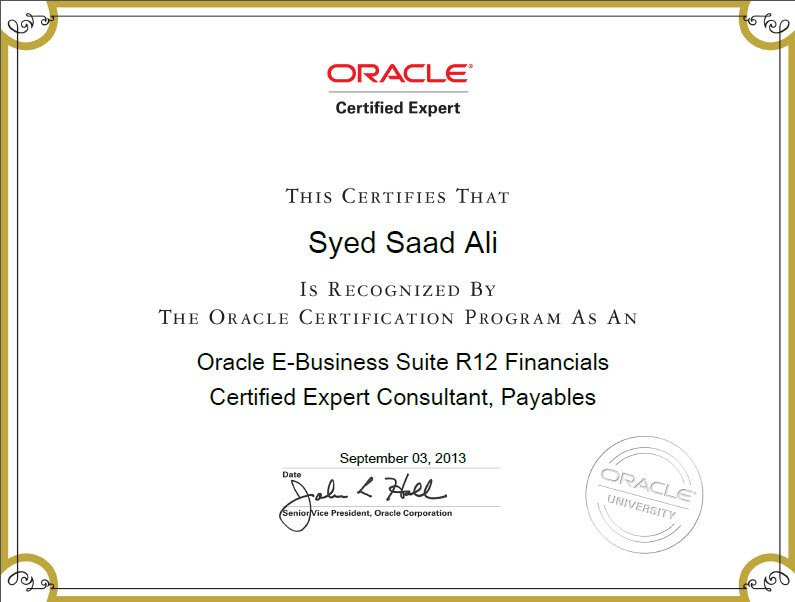
Oracle E-Business Suite R12 Financials Certified Expert  Consultant, PAYABLES 

Certificate
Oracle University
2013
Oracle University
USA

Oracle E-Business Suite R12 Financials Certified Expert  Consultant, PAYABLES 

Certificate
Oracle University
2014
Oracle University
USA

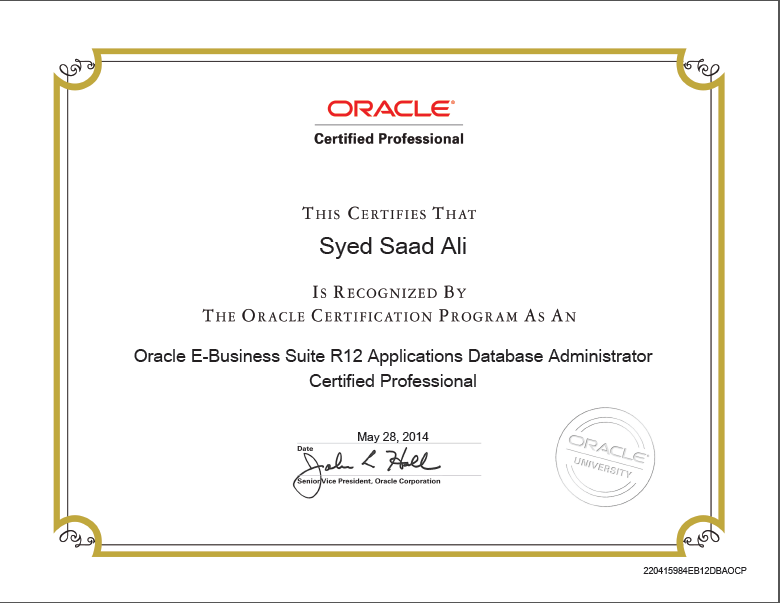
Oracle E-Business Suite R12 Applications Database Administrator Certified Professional 

Certificate
Skills
Oracle Expertise
  • Oracle Databases
  • Oracle E-Business Suite
  • Oracle Weblogic
  • Oracle Cloud Infrastructure
  • Oracle Database Appliances
Languages
  • English
System
  • Linux
    90%
  • Microsoft
    75%
  • SOLARIS
    65%
  • AIX
    60%
Knowledge
  • Installation/Configuration
  • Capacity Planning
  • Data Recovery Plan
  • Oracle Database Migration and Upgrade
  • Oracle ERP Migration and Upgrade
  • Linux and Windows management
  • Performance Evaluation

Blog

August 1, 2017 Apps Technical Interview Questions Part 5
APPS Technical InterviewInterview Questions

[et_pb_section bb_built=”1″ _builder_version=”3.0.52″ background_image=”http://dev.oraclesolutions.pk/wp-content/uploads/2017/07/question-mark-2123967_1920.jpg” parallax=”on” parallax_method=”off” inner_shadow=”on”][et_pb_row _builder_version=”3.0.52″ parallax=”on” parallax_method=”off” background_position_1=”top_left” background_repeat_1=”no-repeat” make_fullwidth=”on” use_custom_width=”on” custom_width_percent=”100%” custom_width_px=”1702px” use_custom_gutter=”on” width_unit=”off” make_equal=”on”][et_pb_column type=”4_4″][et_pb_toggle _builder_version=”3.0.52″ title=”What is Summary columns? ” open=”off” use_background_color_gradient=”on” border_style=”ridge” background_color=”#ffffff” title_font=”Montserrat|on||on|” title_text_color=”#ffffff” body_font=”Montserrat||||” body_font_size=”15″ background_color_gradient_end=”#000000″ background_color_gradient_direction=”181deg” use_border_color=”on” icon_color=”#0c71c3″ title_font_size=”18″ body_line_height=”1em” border_width=”3px” background_color_gradient_start=”#ffffff” open_toggle_text_color=”#ff0000″ body_text_color=”#ffffff”]

  • A summary column performs a computation on another column’s data.
  • Using the Report Wizard or Data Wizard, you can create the following summaries: sum, average, count, minimum, maximum, % total.
  • You can also create a summary column manually in the Data Model view, and use the Property Palette to create the following additional summaries:  first, last, standard deviation, variance.


[/et_pb_toggle][et_pb_toggle _builder_version=”3.0.52″ title=”Can u define exceptions twice in same block?” open=”off” use_background_color_gradient=”on” border_style=”ridge” background_color=”#ffffff” title_font=”Montserrat|on||on|” title_text_color=”#ffffff” body_font=”Montserrat||||” body_font_size=”15″ background_color_gradient_end=”#000000″ background_color_gradient_direction=”181deg” use_border_color=”on” icon_color=”#0c71c3″ title_font_size=”18″ body_line_height=”1em” border_width=”3px” background_color_gradient_start=”#ffffff” open_toggle_text_color=”#ff0000″ body_text_color=”#ffffff”]

NO

[/et_pb_toggle][et_pb_toggle _builder_version=”3.0.52″ title=”Can you have two functions with the same name in a pl/sql block?” open=”off” use_background_color_gradient=”on” border_style=”ridge” background_color=”#ffffff” title_font=”Montserrat|on||on|” title_text_color=”#ffffff” body_font=”Montserrat||||” body_font_size=”15″ background_color_gradient_end=”#000000″ background_color_gradient_direction=”181deg” use_border_color=”on” icon_color=”#0c71c3″ title_font_size=”18″ body_line_height=”1em” border_width=”3px” background_color_gradient_start=”#ffffff” open_toggle_text_color=”#ff0000″ body_text_color=”#ffffff”]

YES

[/et_pb_toggle][et_pb_toggle _builder_version=”3.0.52″ title=”Can you have two stored functions with in the same name?” open=”off” use_background_color_gradient=”on” border_style=”ridge” background_color=”#ffffff” title_font=”Montserrat|on||on|” title_text_color=”#ffffff” body_font=”Montserrat||||” body_font_size=”15″ background_color_gradient_end=”#000000″ background_color_gradient_direction=”181deg” use_border_color=”on” icon_color=”#0c71c3″ title_font_size=”18″ body_line_height=”1em” border_width=”3px” background_color_gradient_start=”#ffffff” open_toggle_text_color=”#ff0000″ body_text_color=”#ffffff”]

YES

[/et_pb_toggle][et_pb_toggle _builder_version=”3.0.52″ title=”Can function be overload?” open=”off” use_background_color_gradient=”on” border_style=”ridge” background_color=”#ffffff” title_font=”Montserrat|on||on|” title_text_color=”#ffffff” body_font=”Montserrat||||” body_font_size=”15″ background_color_gradient_end=”#000000″ background_color_gradient_direction=”181deg” use_border_color=”on” icon_color=”#0c71c3″ title_font_size=”18″ body_line_height=”1em” border_width=”3px” background_color_gradient_start=”#ffffff” open_toggle_text_color=”#ff0000″ body_text_color=”#ffffff”]

YES

[/et_pb_toggle][et_pb_toggle _builder_version=”3.0.52″ title=”What is the maximum number of statements that can be specified in a trigger statement?” open=”off” use_background_color_gradient=”on” border_style=”ridge” background_color=”#ffffff” title_font=”Montserrat|on||on|” title_text_color=”#ffffff” body_font=”Montserrat||||” body_font_size=”15″ background_color_gradient_end=”#000000″ background_color_gradient_direction=”181deg” use_border_color=”on” icon_color=”#0c71c3″ title_font_size=”18″ body_line_height=”1em” border_width=”3px” background_color_gradient_start=”#ffffff” open_toggle_text_color=”#ff0000″ body_text_color=”#ffffff”]

ONE

[/et_pb_toggle][et_pb_toggle _builder_version=”3.0.52″ title=”Can 2 functions have same name & input parameters but differ only by return datatype?” open=”off” use_background_color_gradient=”on” border_style=”ridge” background_color=”#ffffff” title_font=”Montserrat|on||on|” title_text_color=”#ffffff” body_font=”Montserrat||||” body_font_size=”15″ background_color_gradient_end=”#000000″ background_color_gradient_direction=”181deg” use_border_color=”on” icon_color=”#0c71c3″ title_font_size=”18″ body_line_height=”1em” border_width=”3px” background_color_gradient_start=”#ffffff” open_toggle_text_color=”#ff0000″ body_text_color=”#ffffff”]

NO

[/et_pb_toggle][et_pb_toggle _builder_version=”3.0.52″ title=”What is FORWARD DECLARATION in Packages?” open=”off” use_background_color_gradient=”on” border_style=”ridge” background_color=”#ffffff” title_font=”Montserrat|on||on|” title_text_color=”#ffffff” body_font=”Montserrat||||” body_font_size=”15″ background_color_gradient_end=”#000000″ background_color_gradient_direction=”181deg” use_border_color=”on” icon_color=”#0c71c3″ title_font_size=”18″ body_line_height=”1em” border_width=”3px” background_color_gradient_start=”#ffffff” open_toggle_text_color=”#ff0000″ body_text_color=”#ffffff”]

PL/SQL allows for a special subprogram declaration called a forward declaration.It consists of the subprogram specification in the package body terminated by a semicolon.You can use forward declarations to do the following:

  1. Define subprograms in logical or alphabetical order.
  2. Define mutually recursive subprograms.(both calling each other).
  3. Group subprograms in a package

[/et_pb_toggle][et_pb_toggle _builder_version=”3.0.52″ title=”Difference between triggers and procedures?” open=”off” use_background_color_gradient=”on” border_style=”ridge” background_color=”#ffffff” title_font=”Montserrat|on||on|” title_text_color=”#ffffff” body_font=”Montserrat||||” body_font_size=”15″ background_color_gradient_end=”#000000″ background_color_gradient_direction=”181deg” use_border_color=”on” icon_color=”#0c71c3″ title_font_size=”18″ body_line_height=”1em” border_width=”3px” background_color_gradient_start=”#ffffff” open_toggle_text_color=”#ff0000″ body_text_color=”#ffffff”]

Triggers

Procedures

Defined with create trigger Defined with create procedure
The data dictionary contains source code in the user_triggers. Data dictionary contains source code in user_source
Implicitly invoked Explicitly invoked
Commit, save point and rollback are not allowed(TCL) Those are allowed

[/et_pb_toggle][et_pb_toggle _builder_version=”3.0.52″ title=”What do you mean by LOCKS?” open=”off” use_background_color_gradient=”on” border_style=”ridge” background_color=”#ffffff” title_font=”Montserrat|on||on|” title_text_color=”#ffffff” body_font=”Montserrat||||” body_font_size=”15″ background_color_gradient_end=”#000000″ background_color_gradient_direction=”181deg” use_border_color=”on” icon_color=”#0c71c3″ title_font_size=”18″ body_line_height=”1em” border_width=”3px” background_color_gradient_start=”#ffffff” open_toggle_text_color=”#ff0000″ body_text_color=”#ffffff”]

Locks are used to reduce concurrency

SHARE LOCK—it allows the other users for only reading not to insert or update or delete.

EXCLUSIVE LOCK— only one user can have the privileges of insert or update and delete of particular object others can only read.

UPDATE LOCK—-multiple user can read, update delete

Lock levels :

1) TABLE LEVEL

2) TABLE SPACE

3) DATABASE LEVEL.

[/et_pb_toggle][et_pb_toggle _builder_version=”3.0.52″ title=”What is template?” open=”off” use_background_color_gradient=”on” border_style=”ridge” background_color=”#ffffff” title_font=”Montserrat|on||on|” title_text_color=”#ffffff” body_font=”Montserrat||||” body_font_size=”15″ background_color_gradient_end=”#000000″ background_color_gradient_direction=”181deg” use_border_color=”on” icon_color=”#0c71c3″ title_font_size=”18″ body_line_height=”1em” border_width=”3px” background_color_gradient_start=”#ffffff” open_toggle_text_color=”#ff0000″ body_text_color=”#ffffff”]

The TEMPLATE form is the required starting point for all development of new Forms. It includes platform–independent attachments of several Libraries.

  • APPSCORE :- It contains package and procedures that are required of all forms to support  the MENUS ,TOOLBARS.
  • APPSDAYPK :- It contains packages that control the oracle applications CALENDER FEATURES.
  • FNDSQF  :- it contains packages and procedures for MESSAGE DICTONARY, FLEX FIELDS, PROFILES AND CONCURRENT PROCESSING.
  • CUSTOM :- it allows extension of oracle applications forms with out modification of oracle application code, you can use the custom library for customization such as zoom    ( such as moving to another form and querying up specific records)

[/et_pb_toggle][et_pb_toggle _builder_version=”3.0.52″ title=”What is responsibility?” open=”off” use_background_color_gradient=”on” border_style=”ridge” background_color=”#ffffff” title_font=”Montserrat|on||on|” title_text_color=”#ffffff” body_font=”Montserrat||||” body_font_size=”15″ background_color_gradient_end=”#000000″ background_color_gradient_direction=”181deg” use_border_color=”on” icon_color=”#0c71c3″ title_font_size=”18″ body_line_height=”1em” border_width=”3px” background_color_gradient_start=”#ffffff” open_toggle_text_color=”#ff0000″ body_text_color=”#ffffff”]

It is a collection of menus, request security groups and data groups

  1. Menus: collection of forms is nothing but menus
  2. Request security groups: collection of programs.
  3. Data groups: is a group of modules to be made accessible by the user through Responsibility.

[/et_pb_toggle][et_pb_toggle _builder_version=”3.0.52″ title=”What are the validation types?” open=”off” use_background_color_gradient=”on” border_style=”ridge” background_color=”#ffffff” title_font=”Montserrat|on||on|” title_text_color=”#ffffff” body_font=”Montserrat||||” body_font_size=”15″ background_color_gradient_end=”#000000″ background_color_gradient_direction=”181deg” use_border_color=”on” icon_color=”#0c71c3″ title_font_size=”18″ body_line_height=”1em” border_width=”3px” background_color_gradient_start=”#ffffff” open_toggle_text_color=”#ff0000″ body_text_color=”#ffffff”]

None:   validation is minimal.

Independent ——input must exist on previously defined list of values

Dependent    ——input is checked against a subset of values based on a prior value.

Table             —– input is checked against values in an application table

Special          ——values set uses a flex field itself.

Pair              —— two flex fields together specify a range of valid values.

Translatable independent —– input must exist on previously defined list of values; translated values can be used.

Translatable dependent ——- input is checked against a subset of values based on a prior values; translated value can be used.

[/et_pb_toggle][/et_pb_column][/et_pb_row][/et_pb_section]

July 30, 2017 CPADMIN Utility Now Available for EBS
NEWS AND UPDATES

CPADMIN Utility Now Available for EBS 12.2.3, 12.2.4, 12.2.5

By: Steven Chan| Senior Director

I recently profiled the CPADMIN utility for EBS 12.2.6 that consolidates various CP management functions into a single menu-based tool.  This ADADMIN-style utility can:

  • View Concurrent Manager status
  • Clean CP tables
  • Set Concurrent Manager diagnostics
  • Start, stop, or verify an individual Concurrent Manager
  • Rebuild Concurrent Manager views
  • Move request files
  • Analyze requests
  • Configure request log/out file directory locations

This tool has been backported to EBS 12.2.3, 12.2.4, and 12.2.5 via Patch 24408550:

In case you missed it, this tool is also available for EBS 12.1.3.

Related Articles

Source:https://blogs.oracle.com/stevenchan/cpadmin-utility-now-available-for-ebs-1223%2c-1224%2c-1225


July 30, 2017 Oracle Has a SPARC-powered Exadata Configuration Called SuperCluster
NEWS AND UPDATES

Oracle Has a SPARC-powered Exadata Configuration Called SuperCluster

Oracle has been shipping an Oracle Exadata configuration that runs Oracle’s T and M-series (SPARC) microprocessors for more than 2 years. This database machine is called Oracle SuperCluster.

Technically, SuperCluster has always included every single Exadata feature of note. This is because every SuperCluster configuration is built around the same Exadata Storage Serversand InfiniBand switches that are used in every other Exadata system configuration.

Exadata Storage server

In the case of the SuperCluster configurations, however, we have added Oracle T and M-series microprocessors to the compute nodes (used for running Oracle Database and other software) and ZS3-ES storage (used for pre-11gR2 Oracle Database storage, virtual machine images and other data needed by the system). SuperCluster is a ‘hybrid’ system that integrates both x86 processors and Oracle’s T and M-series microprocessors in the interest of achieving the greatest flexibility, performance, efficiency and reliability possible.
Both SuperCluster and Exadata X-series configurations are equally well suited to all of the major classes of Oracle Database use cases: OLTP, Data Warehouse, Database Consolidation and Database-as-a-Service (DBaaS). There are technical differences, however, which make SuperCluster the right first choice for some customers or projects.

SuperCluster offers several important features that are not available today in other Exadata configurations:

  • Support for multi-tenancy through virtualization (which some customers prefer, rather than using the Plug-able Database (PDB) approach pioneered in Oracle Database 12c, for example)
  • Oracle’s T and M-series microprocessors (which deliver world-record-breaking Oracle Database performance)
  • Larger blocks of contiguous memory (ECC DRAM) and more memory per processor (ideal for in-memory workloads and large vertically scaled databases)
  • Support for multiple database versions concurrently, including pre 11gR2 Oracle Database
  • Direct integration with existing Storage Area Networks via the optional addition of Fibre Channel Host Bus Adapters (FC HBAs)
  • Support for running application-tier workloads along with Oracle Database, to further improve overall application performance, reliability and consolidation density where desired
  • More compute power per gigabyte of included Exadata Storage Server capacity (although Exadata Storage Expansion Racks may be added if desired)

Exadata configurations, on the other hand, offer some capabilities that are essential in some cases:

  • They can run either Oracle Linux and Oracle Solaris operating systems, whereas SuperCluster only supports Solaris
  • They have more Exadata Storage Server capacity per processor than SuperCluster in their factory configurations
  • They come in very small Quarter Rack or Eighth Rack configurations, while the smallest SuperCluster configuration is a Half Rack.

So which configuration should you choose?
The guidance we offer customers about whether to choose an Exadata or SuperCluster configuration is fairly simple: both Exadata and SuperCluster configurations are equally optimized for Oracle Database and can, in fact, be deployed together to create a single system for customers that require maximum flexibility.  For customers currently running Oracle Database (or other databases) in mission-critical deployments on UNIX/RISC platforms (such as PowerSPARC or Itanium), SuperCluster would be the natural first candidate because of it’s familiarity, technical similarity and feature set.  Conversely, customers running Oracle Database with Oracle Real Application Cluster (RAC) in commodity x86 server environments will likely find the Exadata X-series configurations to be the most natural first choice. In most cases, the decision about which configuration to deploy will be driven by technical needs, and the distinctions outlined above are sufficiently straightforward to interpret without appreciable risk or uncertainty.

Source: https://blogs.oracle.com/oracle-systems/oracle-has-a-sparc-powered-exadata-configuration-called-supercluster

July 27, 2017 Quarterly EBS Upgrade Recommendations: July 2017 Edition
NEWS AND UPDATES

Quarterly EBS Upgrade Recommendations: July 2017 Edition

By: Steven Chan | Senior Director

We’ve previously provided advice on the general priorities for applying EBS updates and creating a comprehensive maintenance strategy.

Here are our latest upgrade recommendations for E-Business Suite updates and technology stack components.  These quarterly recommendations are based upon the latest updates to Oracle’s product strategies, latest support timelines, and newly-certified releases.

You can research these yourself using this Note:

Upgrade Recommendations for July 2017

EBS 12.2  EBS 12.1  EBS 12.0  EBS 11.5.10
Check your EBS support status and patching baseline Apply the minimum 12.2 patching baseline
(EBS 12.2.3 + latest technology stack updates listed below)In Premier Support to September 30, 2023
Apply the minimum 12.1 patching baseline
(12.1.3 Family Packs for products in use + latest technology stack updates listed below)In Premier Support to December 31, 2021
In Sustaining Support. No new patches available.

Upgrade to 12.1.3 or 12.2

Before upgrading, 12.0 users should be on the minimum 12.0 patching baseline

In Sustaining Support. No new patches available.

Upgrade to 12.1.3 or 12.2

Before upgrading, 11i users should be on the minimum 11i patching baseline

Apply the latest EBS suite-wide RPC or RUP 12.2.6
Sept. 2016
12.1.3 RPC5
Aug. 2016
12.0.6
11.5.10.2
Use the latest Rapid Install StartCD 51
Feb. 2016
StartCD 13
Aug. 2011
12.0.6 11.5.10.2
Apply the latest EBS technology stack, tools, and libraries AD/TXK Delta 9
Apr. 2017FND
Apr. 2017

EBS 12.2.6 OAF Update 4

EBS 12.2.5 OAF Update 13
Jun. 2017

EBS 12.2.4 OAF Update 15
Mar. 2017

ETCC
May 2017

Web Tier Utilities 11.1.1.9

Daylight Savings Time DSTv28
Nov. 2016

FND
Apr. 2017OAF Bundle 5
Jun. 2016

JTT Update 4
Oct. 2016

Daylight Savings Time DSTv28
Nov. 2016

Apply the latest security updates Jul. 2017 Critical Patch Update

SHA-2 PKI Certificates

SHA-2 Update for Web ADI & Report Manager

Migrate from SSL or TLS 1.0 to TLS 1.2

Sign JAR files

Jul. 2017 Critical Patch Update

SHA-2 PKI Certificates

SHA-2 Update for Web ADI & Report Manager

Migrate from SSL or TLS 1.0 to TLS 1.2

Sign JAR files

Oct. 2015 Critical Patch Update April 2016 Critical Patch Update
Use the latest certified desktop components Use the latest JRE 1.8, 1.7, or 1.6 release that meets your requirements.

Switch to Java Web Start

Upgrade to IE 11

Upgrade to Firefox ESR 52

Upgrade Office 2003 and Office 2007 to later Office versions (e.g. Office 2016)

Upgrade Windows XP and Vista and Win 10v1507 to later versions (e.g. Windows 10v1607)

Use the latest JRE 1.8, 1.7, or 1.6 release that meets your requirements

Switch to Java Web Start

Upgrade to IE 11

Upgrade to Firefox ESR 52

Upgrade Office 2003 and Office 2007 to later Office versions (e.g. Office 2016)

Upgrade Windows XP and Vista and Win 10v1507 to later versions (e.g. Windows 10v1607)

Upgrade to the latest database Database 11.2.0.4or 12.1.0.2 Database 11.2.0.4or 12.1.0.2 Database 11.2.0.4or 12.1.0.2 Database 11.2.0.4or 12.1.0.2
If you’re using Oracle Identity Management Upgrade to Oracle Access Manager 11.1.2.3

Upgrade to Oracle Internet Directory 11.1.1.9

Migrate from Oracle SSO to OAM 11.1.2.3

Upgrade to Oracle Internet Directory 11.1.1.9

If you’re using Oracle Discoverer Migrate to Oracle
Business Intelligence Enterprise Edition (OBIEE), Oracle Business
Intelligence Applications (OBIA).Discoverer 11.1.1.7 is in Sustaining Support as of June 2017
Migrate to Oracle
Business Intelligence Enterprise Edition (OBIEE), Oracle Business
Intelligence Applications (OBIA).Discoverer 11.1.1.7 is in Sustaining Support as of June 2017
If you’re using Oracle Portal Migrate to Oracle WebCenter  11.1.1.9 Migrate to Oracle WebCenter 11.1.1.9 or upgrade to Portal 11.1.1.6 (End of Life Jun. 2017).


July 18, 2017 Check Your EBS Database Configuration with Database Parameter Settings Analyzer
NEWS AND UPDATES

Check Your EBS Database Configuration with Database Parameter Settings Analyzer

By: Steven Chan | Senior Director

Database ParaIn addition to helping customers resolve issues via Service Requests, Oracle Support also builds over 60 free diagnostic tools for Oracle E-Business Suite 12.2, 12.0, 12.1, and 11i. These Support Analyzers are non-invasive scripts that run health-checks on your EBS environments. They look for common issues and generate standardized reports summarizing that provide solutions for known issues and recommendations on best practices.

Here’s an index to these tools:

Spotlight on Database Parameter Settings Analyzer

We publish a definitive list of Oracle Database initialization parameter settings for the optimal performance of Oracle E-Business Suite 12.2, 12.1, and 12.0:

This document is updated regularly; for example, it was recently updated to account for changes introduced by the April 2017 updates to the AD and TXK utilities.

It can be challenging to keep up with those changes simply by scanning Note 396009.1 yourself.  You can automate this process by using the Database Parameter Settings Analyzer:

The Database Parameter Settings Analyzer compares your database’s parameter settings to the latest recommendations in Note 396009.1.  It reports on any differences, and makes recommendations about your sga_target, shared_pool_size, shared_pool_reserved_size and processes parameters based upon the number of active users for your environment.

This tool can be run manually or configured to run as a concurrent request, so it can be scheduled to be run periodically and included in regular database maintenance cycles.

Can this script be run against Production?

Yes. There is no DML in the Analyzer Script, so it is safe to run against Production instances to get an analysis of the environment for a specific instance. As always it is recommended to test all suggestions against a TEST instance before applying to Production.

Source: https://blogs.oracle.com/stevenchan/check-your-ebs-database-configuration-with-database-parameter-settings-analyzer

July 13, 2017 Mobile Approvals 1.6 Now Available for iOS and Android
NEWS AND UPDATES

Mobile Approvals 1.6 Now Available for iOS and Android

By: Steven Chan| Senior Director

We are pleased to announce updates for the Oracle E-Business Suite Mobile Approvals 1.6 smartphone app for iOS and Android. These updates are delivered as part of Oracle E-Business Suite Mobile Release 7, which supports both Oracle E-Business Suite Release 12.1.3 and 12.2.3 and beyond.  Oracle E-Business Suite Mobile Release 7 is a coordinated release of 17 Oracle E-Business Suite mobile apps, excluding Mobile Expenses and Mobile Field Service, which have their own off-cycle releases.
For information on the Approvals app, see:

For more details on the updates for all EBS mobile apps, see:

What’s New in Mobile Approvals 1.6

  • Ability to reassign an approval notification
  • Support for push notifications when using Oracle Mobile Cloud Service and enterprise distribution
  • Mobile Foundation:
    • Ability to import custom CA or self-signed server certificates to standard apps for TLS connections to Oracle E-Business Suite
    • Ability to download the mobile app configuration automatically from the server
    • Technical updates with uptake of Oracle Mobile Application Framework (MAF) 2.4.0

Related Articles

Source: https://blogs.oracle.com/stevenchan/approvals-16-now-available-for-ios-and-android


Contact

Get in Touch
  • Address: Karachi, PAKISTAN
  • Email: askme@SyedSaadAli.com
  • Phone: +92-300-026-5668
  • Freelance: Available
Contact Form