

Syed Saad Ali

Oracle ACE Pro

Oracle Solution Architect

Oracle E-Business Suite

Oracle Cloud Infrastructure

Oracle Fusion Middleware

Oracle Database Administration

Oracle Weblogic Administration

Syed Saad Ali

Oracle ACE Pro

Oracle Solution Architect

Oracle E-Business Suite

Oracle Cloud Infrastructure

Oracle Fusion Middleware

Oracle Database Administration

Oracle Weblogic Administration

Home

About Me

Technically-sophisticated professional with extensive experience in updating server security, executing routine back-ups, and designing and implementing tests of the system to address issues with accessing data

  • Adept at leading the planning, designing, developing, testing, and deploying efficient solutions within Oracle EBS system, in order to satisfy strategic, financial, and operations needs of the organization.
  • Skilled in planning and managing successful projects, mitigating risks, controlling costs, and directing project teams. Instrumental in monitoring routine maintenance of system, implementing the ERP systems, and approving budget.
  • Proven success in analyzing business processes/process re-engineering and recommending solutions. Deft at establishing IT service continuity management strategies, disaster recovery plans and associated test procedures of each critical functional area of the organization.
  • Age: 37
  • Residence: Pakistan
  • Freelance: Available
  • Address: Karachi, PAKISTAN
My Services
Oracle E-Business Suite Upgrade
Oracle E-Business Suite Migration
Oracle Database Upgrade or Migrate
Oracle Maximum Availability Architecture
Performance Evaluation
Pricing
Hire Me On Upwork
$ 35 Hour
  • Database Administration
  • Oracle E-Business Suite Administration
  • Configuration, Administration, Cloning, Patching, Migrating, Support, Maintenance, Monitoring, tuning and capacity planning, User Management, Backup/Recovery Management

Hire Me on Fiverr
$ 35 Hour
  • Database Administration
  • Oracle E-Business Suite Administration
  • Configuration, Administration, Cloning, Patching, Migrating, Support, Maintenance, Monitoring, tuning and capacity planning, User Management, Backup/Recovery Management
Hire Team
$ 40 Hour
  • Database Administration
  • Oracle E-Business Suite Administration
  • Configuration, Administration, Cloning, Patching, Migrating, Support, Maintenance, Monitoring, tuning and capacity planning, User Management, Backup/Recovery Management

Resume

Experience
2024-
Senior Apps DBA
Private Contractor
My role includes infrastructure support, capacity planning, installation, configuration, database design, and migration, up gradation, performance monitoring, security,  database backups, data recovery plan, and procedures including application server administration
Senior Apps DBA
2022- 2024
Senior Apps DBA
Computer & Systems Engineering Company
My role includes infrastructure support, capacity planning, installation, configuration, database design, and migration, up gradation, performance monitoring, security,  database backups, data recovery plan, and procedures including application server administration
Lead Infrastructure Consultant
2020-2021
Lead Infrastructure Consultant
ITANZ Group
Managed Oracle cloud infrastructure, compute, storage, networking, connectivity, and edge service, database management, analytics, integration, and Oracle weblogic clustering environment over Oracle Cloud IAAS.  Collaborated with the Oracle corporation staff for offering technical support to diagnose and troubleshoot common problems.
Professional Freelancer
2020 - 2022
Professional Freelancer
Upwork Inc.
Collaborated with Clients for the Task Related to Oracle Database, Oracle E-Business Suite, Oracle Cloud Infrastructure, Oracle Weblogic
Assistant Director (Databases)
2015-2020
Assistant Director (Databases)
Pakistan Civil Aviation Authority
Managed ERP for implementing the structures effectively, while limiting the resources consumed in the planning process. Improved IT/business processes and investigations to resolve the user’s issues as well as offered user’s training to help the user in operating the system in efficient way.
Education
Newports Institute Of Communication & Economics
2008 - 2011
Newports Institute Of Communication & Economics
Pakistan

Newports Institute Of Communication & Economics offers a B.S. in Computer Science.

Certificate
Oracle University
2013
Oracle University
USA

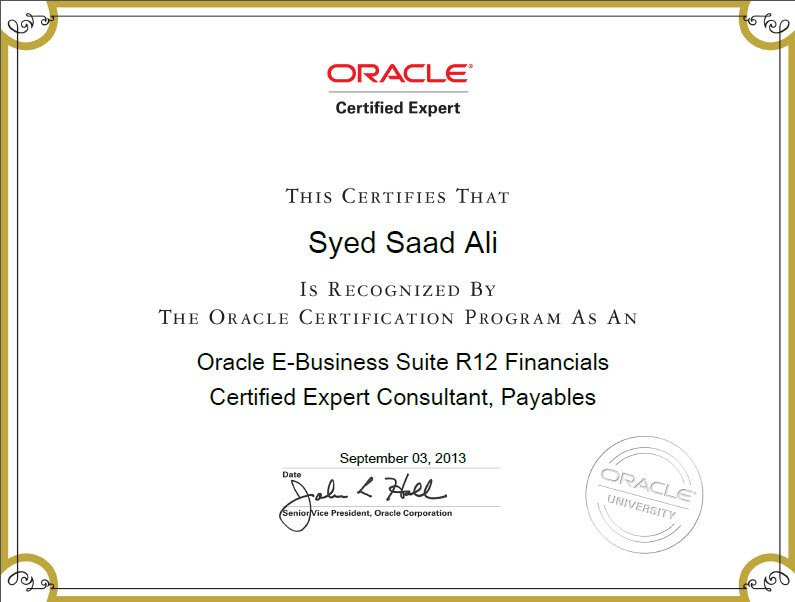
Oracle E-Business Suite R12 Financials Certified Expert  Consultant, PAYABLES 

Certificate
Oracle University
2013
Oracle University
USA

Oracle E-Business Suite R12 Financials Certified Expert  Consultant, PAYABLES 

Certificate
Oracle University
2014
Oracle University
USA

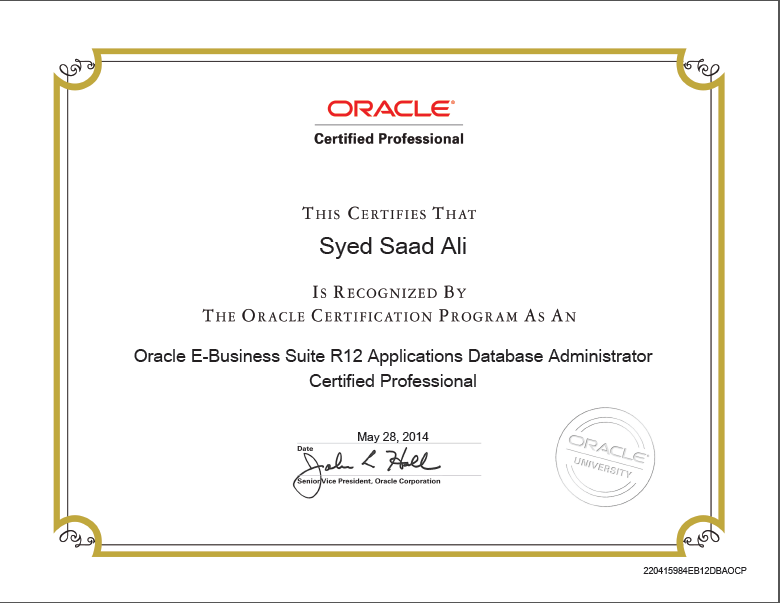
Oracle E-Business Suite R12 Applications Database Administrator Certified Professional 

Certificate
Skills
Oracle Expertise
  • Oracle Databases
  • Oracle E-Business Suite
  • Oracle Weblogic
  • Oracle Cloud Infrastructure
  • Oracle Database Appliances
Languages
  • English
System
  • Linux
    90%
  • Microsoft
    75%
  • SOLARIS
    65%
  • AIX
    60%
Knowledge
  • Installation/Configuration
  • Capacity Planning
  • Data Recovery Plan
  • Oracle Database Migration and Upgrade
  • Oracle ERP Migration and Upgrade
  • Linux and Windows management
  • Performance Evaluation

Blog

June 8, 2017 Webcast: Advanced Architectures for Oracle E-Business Suite
NEWS AND UPDATES

Webcast: Advanced Architectures for Oracle E-Business Suite

By: Steven Chan| Senior Director

Oracle University has a large number of free recorded webcasts for Oracle E-Business Suite.  Here’s an excellent webcast for a wide range of architectural options for more-complex deployment requirements:

Elke Phelps, Senior Principal Product Manager shares how to build on the three-tier logical Oracle E-Business Suite architecture to meet your business requirements for high availability, scalability, and performance. Topics include load-balancing and clustering. Understand how to securely deploy Oracle E-Business Suite for internet access with a demilitarized zone (DMZ). Apply various topics covered in the session to assist you with planning a disaster recovery project for your environment. Learn about new tools that automate scale-out and other advanced architectures when deploying E-Business Suite to the Oracle Cloud. This material was presented at Oracle OpenWorld 2016.

Source: https://blogs.oracle.com/stevenchan/webcast%3a-advanced-architectures-for-oracle-e-business-suite


June 8, 2017 Where Can I Find the Latest Patch Wizard Updates for EBS 12.2?
NEWS AND UPDATES

Where Can I Find the Latest Patch Wizard Updates for EBS 12.2?

By: Steven Chan| Senior Director

Patch Wizard helps you identify useful or critical missing patches for your EBS environment.

This tool is updated as needed, with patches that are cumulative: they include new updates as well as all fixes released previously.  The latest updates are always documented here:

The last updates to the EBS 12.2 Patch Wizard were released in September 2016 via this patch:

This patch fixed the following issues:

  • 14504286 – PATCH WIZARD – 12.1.3 – MANY PATCHES ARE INDIRECTLY APPLIED BUT MARKED UNAPPLIED
  • 16992893 – PATCH WIZARD: PATCH MERGE FAILING – UNABLE TO FIND PATCH FILES
  • 17081891 – 16992893 PCC – PATCH WIZARD: PATCH MERGE FAILING – UNABLE TO FIND PATCH FILES
  • 17244500 – PATCH WIZARD IS RECOMMENDING PATCHES FOR IN USE PRODUCTS = NO
  • 17335985 – 17244500 PCC – PATCH WIZARD IS RECOMMENDING PATCHES FOR IN USE PRODUCTS = NO
  • 17355203 – PCC 14504286 – MANY PATCHES ARE INDIRECTLY APPLIED BUT MARKED UNAPPLIED
  • 18617040 – PATCH WIZARD: ORA-06512: AT “APPS.AD_PATCH_ANALYSIS_ENGINE”, LINE 519
  • 18978837 – R12.2 OAM APPLIED PATCHES PROVIDES WRONG DATES, DOES NOT SHOW ALL PATCHES
  • 19412224 – FLAGGED FILE IMPORTS HANG AFTER 18598941
  • 20318695 – ADPAENGB.PLS 120.13.12020000.8 CAUSES ORA-06512 IN EBS R12.2.3
  • 21184697 – CAN’T FIND RESOURCE FOR BUNDLE ORACLE.APPS.AD.OAM.RESOURCES.PATCHRESOURCEBUNDLE
  • 21806033 – PATCH WIZARD APPLIED PATCHES ADVANCED SEARCH BY PRODUCT IS NOT WORKING
  • 22490144 – FILE HISTORY NOT SHOWING CORRECT VERSIONS OF THE ACTUAL APPLIED/UPLOADED FILES.
  • 9703082 – PROVIDE REPORT OR EXPORT BUTTON FOR PATCH WIZARD OUTPUT SUMMARY+IMPACT ANALYSIS

Related Articles

Source:https://blogs.oracle.com/stevenchan/where-can-i-find-the-latest-patch-wizard-updates-for-ebs-122


June 7, 2017 PL/Sql Interview Questions Part 4
Database Interview QuestionsInterview Questions

1. What will you get by the cursor attribute SQL%FOUND?


It returns the Boolean value TRUE if at least one row was processed.


2. What will you get by the cursor attribute SQL%NOTFOUND?


It returns the Boolean value TRUE if no rows were processed.


3. What do you understand by PL/SQL packages?


  • A PL/SQL package can be specified as a file that groups functions, cursors, stored procedures, and variables in one place.


4. What are the two different parts of the PL/SQL packages?


PL/SQL packages have the following two parts:

  • Specification part: It specifies the part where the interface to the application is defined.
  • Body part: This part specifies where the implementation of the specification is defined.


5. Which command is used to delete a package?


  • The DROP PACKAGE command is used to delete a package.


6. How to execute a stored procedure?


There are two way to execute a stored procedure.

From the SQL prompt, write EXECUTE or EXEC followed by procedure_name.

  •  EXECUTE or [EXEC] procedure_name;

Simply use the procedure name

  • procedure_name;


7. What are the advantages of stored procedure?

  • Modularity, extensibility, reusability, Maintainability and one time compilation.


8. What are the cursor attributes used in PL/SQL?


  • %ISOPEN: it checks whether the cursor is open or not.
  • %ROWCOUNT: returns the number of rows affected by DML operations:                                                                                           INSERT,DELETE,UPDATE,SELECT.
  • %FOUND: it checks whether cursor has fetched any row. If yes TRUE.
  • %NOTFOUND: it checks whether cursor has fetched any row. If no TRUE.


9. What is the difference between syntax error and runtime error?


  • A syntax error can be easily detected by a PL/SQL compiler.
  • For example: incorrect spelling etc.
  • A runtime error is handled with the help of exception-handling section in a PL/SQL block.
  • For example: SELECT INTO statement, which does not return any rows.


10. Explain the Commit statement?


Following conditions are true for the Commit statement:

  • Other users can see the data changes made by the transaction.
  • The locks acquired by the transaction are released.
  • The work done by the transaction becomes permanent.


11. Explain the Rollback statement?

The Rollback statement is issued when the transaction ends. Following conditions are true for a Rollback statement:

  • The work done in a transition is undone as if it was never issued.
  • All locks acquired by transaction are released.


12. Explain the SAVEPOINT statement?


With SAVEPOINT, only part of transaction can be undone.


13. What is mutating table error?


  • Mutating table error is occurred when a trigger tries to update a row that it is currently using.
  • It is fixed by using views or temporary tables.


14. What is consistency?


Consistency simply means that each user sees the consistent view of the data.


15. What is cursor and why it is required?


  • A cursor is a temporary work area created in a system memory when an SQL statement is executed.
  • A cursor contains information on a select statement and the row of data accessed by it.
  • This temporary work area stores the data retrieved from the database and manipulate this data.
  • A cursor can hold more than one row, but can process only one row at a time.
  • Cursor are required to process rows individually for queries.


16. How many types of cursors are available in PL/SQL?


There are two types of cursors in PL/SQL.

  1. Implicit cursor, and
  2. explicit cursor


June 7, 2017 PL/Sql Interview Questions Part 3
Database Interview QuestionsInterview Questions

1. What are some predefined exceptions in PL/SQL?

A list of predefined exceptions in PL/SQL:

  • DUP_VAL_ON_INDEX
  • ZERO_DIVIDE
  • NO_DATA_FOUND
  • TOO_MANY_ROWS
  • CURSOR_ALREADY_OPEN
  • INVALID_NUMBER
  • INVALID_CURSOR
  • PROGRAM_ERROR
  • TIMEOUT _ON_RESOURCE
  • STORAGE_ERROR
  • LOGON_DENIED
  • VALUE_ERROR
  • etc.


2. What is a trigger in PL/SQL?


  • A trigger is a PL/SQL program which is stored in the database.
  • It is executed immediately before or after the execution of INSERT, UPDATE, and DELETE commands.


3. What is the maximum number of triggers, you can apply on a single table?


12 triggers.


4. How many types of triggers exist in PL/SQL?


There are 12 types of triggers in PL/SQL that contains the combination of BEFORE, AFTER, ROW, TABLE, INSERT, UPDATE, DELETE and ALL keywords.

  • BEFORE ALL ROW INSERT
  • AFTER ALL ROW INSERT
  • BEFORE INSERT
  • AFTER INSERT etc.


5. What is the difference between execution of triggers and stored procedures?


  • A trigger is automatically executed without any action required by the user, while a stored procedure is explicitly invoked by the user.


6. What happens when a trigger is associated to a view?


  • When a trigger is associated to a view, the base table triggers are normally enabled.


7. What is the usage of WHEN clause in trigger?


  • A WHEN clause specifies the condition that must be true for the trigger to be triggered.


8. How to disable a trigger name update_salary?


  • ALTER TRIGGER update_salary DISABLE;


9. Which command is used to delete a trigger?


  • DROP TRIGGER command.


10. what are the two virtual tables available at the time of database trigger execution?


Table columns are referred as THEN.column_name and NOW.column_name.

  • For INSERT related triggers, NOW.column_name values are available only.
  • For DELETE related triggers, THEN.column_name values are available only.
  • For UPDATE related triggers, both Table columns are available.


11. What is stored Procedure?


A stored procedure is a sequence of statement or a named PL/SQL block which performs one or more specific functions.

  • It is similar to a procedure in other programming languages.
  • It is stored in the database and can be repeatedly executed.
  • It is stored as schema object.
  • It can be nested, invoked and parameterized.


12. What are the different schemas objects that can be created using PL/SQL?


  • Stored procedures and functions
  • Packages
  • Triggers
  • Cursors


13. What do you know by PL/SQL Cursors?


  • Oracle uses workspaces to execute the SQL commands.
  • When Oracle processes a SQL command, it opens an area in the memory called Private SQL Area.
  • This area is identified by the cursor.
  • It allows programmers to name this area and access it’s information.


14. What is the difference between the implicit and explicit cursors?


  • Implicit cursor is implicitly declared by Oracle.
  • This is a cursor to all the DDL and DML commands that return only one row.
  • Explicit cursor is created for queries returning multiple rows.


15. What will you get by the cursor attribute SQL%ROWCOUNT?


  • The cursor attribute SQL%ROWCOUNT will return the number of rows that are processed by a SQL statement.


June 6, 2017 Webcast: Standards-based Desktop Integration in Oracle E-Business Suite
NEWS AND UPDATES

Webcast: Standards-based Desktop Integration in Oracle E-Business Suite

By: Steven Chan| Senior Director

Oracle University has a large number of free recorded webcasts for Oracle E-Business Suite.  Here’s a useful one on Web Applications Desktop Integrator (Web ADI) and Oracle Report Manager:

Padmabrabodh Ambale covers the latest standards support in Oracle Web Applications Desktop Integrator and Oracle Report Manager. The session includes new features in Release 12.2 and other proposed design changes that result in vastly improved performance and spreadsheet experience. In addition, it offers information on how you can use Desktop Integration Framework to build your own custom desktop integrations between Oracle E-Business Suite and Microsoft Excel for enhanced end user productivity for mass upload/download of spreadsheet data. This material was presented at Oracle OpenWorld 2015.

Related Articles

Source:https://blogs.oracle.com/stevenchan/webcast%3a-standards-based-desktop-integration-in-oracle-e-business-suite


June 6, 2017 Providing Limited Patch Wizard Access to EBS End-Users
NEWS AND UPDATES

Providing Limited Patch Wizard Access to EBS End-Users

By: Steven Chan | Senior Director

Patch Wizard helps you identify useful or critical missing patches for your EBS environment.

One of the most common questions we get is how to provide Patch Wizard access to end-users without giving them full access to the rest of the system administration features included with the System Administration responsibility.

In response to these questions, we created a responsibility for Non-Sysadmin users that contains only the Patch Wizard screens. Tips on using this new responsibility are covered here:

  • Patch Wizard FAQ (Note 976688.2) – see tab “Setup Patch Wizard Responsibility for End Users”

This Note shows how to create a new Patch Wizard responsibility for end-users, how to configure preferences and how to add restrictions for specific menus and functions.

References

Related Articles

Source:https://blogs.oracle.com/stevenchan/setup-patch-wizard-responsibility-for-end-users-v2


Contact

Get in Touch
  • Address: Karachi, PAKISTAN
  • Email: askme@SyedSaadAli.com
  • Phone: +92-300-026-5668
  • Freelance: Available
Contact Form