Syed Saad Ali

Oracle ACE Pro

Oracle Solution Architect

Oracle E-Business Suite

Oracle Cloud Infrastructure

Oracle Fusion Middleware

Oracle Database Administration

Oracle Weblogic Administration

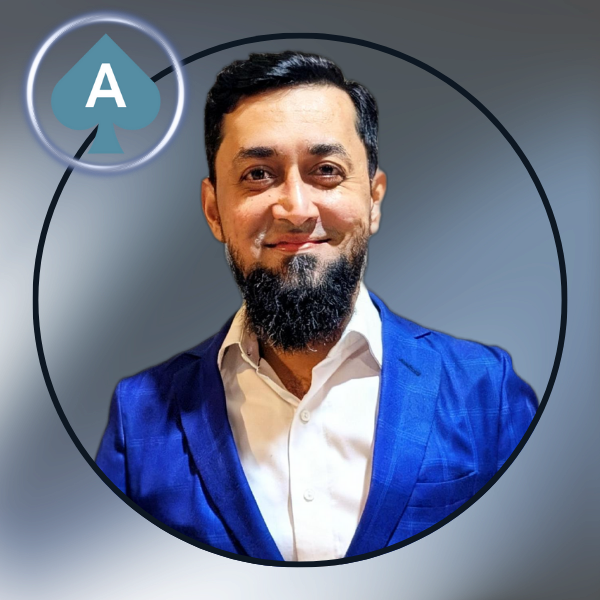
Syed Saad Ali

Oracle ACE Pro

Oracle Solution Architect

Oracle E-Business Suite

Oracle Cloud Infrastructure

Oracle Fusion Middleware

Oracle Database Administration

Oracle Weblogic Administration

Home

About Me

Technically-sophisticated professional with extensive experience in updating server security, executing routine back-ups, and designing and implementing tests of the system to address issues with accessing data

  • Adept at leading the planning, designing, developing, testing, and deploying efficient solutions within Oracle EBS system, in order to satisfy strategic, financial, and operations needs of the organization.
  • Skilled in planning and managing successful projects, mitigating risks, controlling costs, and directing project teams. Instrumental in monitoring routine maintenance of system, implementing the ERP systems, and approving budget.
  • Proven success in analyzing business processes/process re-engineering and recommending solutions. Deft at establishing IT service continuity management strategies, disaster recovery plans and associated test procedures of each critical functional area of the organization.
  • Age: 37
  • Residence: Pakistan
  • Freelance: Available
  • Address: Karachi, PAKISTAN
My Services
Oracle E-Business Suite Upgrade
Oracle E-Business Suite Migration
Oracle Database Upgrade or Migrate
Oracle Maximum Availability Architecture
Performance Evaluation
Pricing
Hire Me On Upwork
$ 35 Hour
  • Database Administration
  • Oracle E-Business Suite Administration
  • Configuration, Administration, Cloning, Patching, Migrating, Support, Maintenance, Monitoring, tuning and capacity planning, User Management, Backup/Recovery Management

Hire Me on Fiverr
$ 35 Hour
  • Database Administration
  • Oracle E-Business Suite Administration
  • Configuration, Administration, Cloning, Patching, Migrating, Support, Maintenance, Monitoring, tuning and capacity planning, User Management, Backup/Recovery Management
Hire Team
$ 40 Hour
  • Database Administration
  • Oracle E-Business Suite Administration
  • Configuration, Administration, Cloning, Patching, Migrating, Support, Maintenance, Monitoring, tuning and capacity planning, User Management, Backup/Recovery Management

Resume

Experience
2024-
Senior Apps DBA
Private Contractor
My role includes infrastructure support, capacity planning, installation, configuration, database design, and migration, up gradation, performance monitoring, security,  database backups, data recovery plan, and procedures including application server administration
Senior Apps DBA
2022- 2024
Senior Apps DBA
Computer & Systems Engineering Company
My role includes infrastructure support, capacity planning, installation, configuration, database design, and migration, up gradation, performance monitoring, security,  database backups, data recovery plan, and procedures including application server administration
Lead Infrastructure Consultant
2020-2021
Lead Infrastructure Consultant
ITANZ Group
Managed Oracle cloud infrastructure, compute, storage, networking, connectivity, and edge service, database management, analytics, integration, and Oracle weblogic clustering environment over Oracle Cloud IAAS.  Collaborated with the Oracle corporation staff for offering technical support to diagnose and troubleshoot common problems.
Professional Freelancer
2020 - 2022
Professional Freelancer
Upwork Inc.
Collaborated with Clients for the Task Related to Oracle Database, Oracle E-Business Suite, Oracle Cloud Infrastructure, Oracle Weblogic
Assistant Director (Databases)
2015-2020
Assistant Director (Databases)
Pakistan Civil Aviation Authority
Managed ERP for implementing the structures effectively, while limiting the resources consumed in the planning process. Improved IT/business processes and investigations to resolve the user’s issues as well as offered user’s training to help the user in operating the system in efficient way.
Education
Newports Institute Of Communication & Economics
2008 - 2011
Newports Institute Of Communication & Economics
Pakistan

Newports Institute Of Communication & Economics offers a B.S. in Computer Science.

Certificate
Oracle University
2013
Oracle University
USA

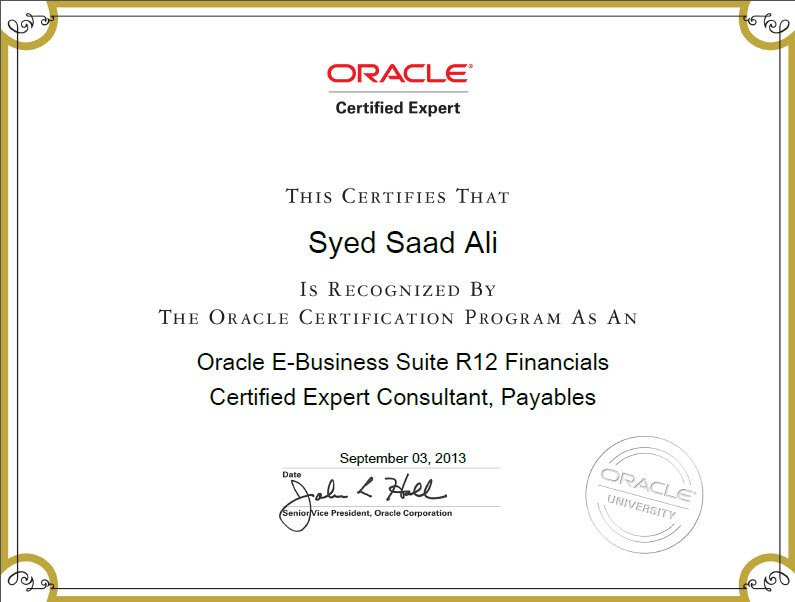
Oracle E-Business Suite R12 Financials Certified Expert  Consultant, PAYABLES 

Certificate
Oracle University
2013
Oracle University
USA

Oracle E-Business Suite R12 Financials Certified Expert  Consultant, PAYABLES 

Certificate
Oracle University
2014
Oracle University
USA

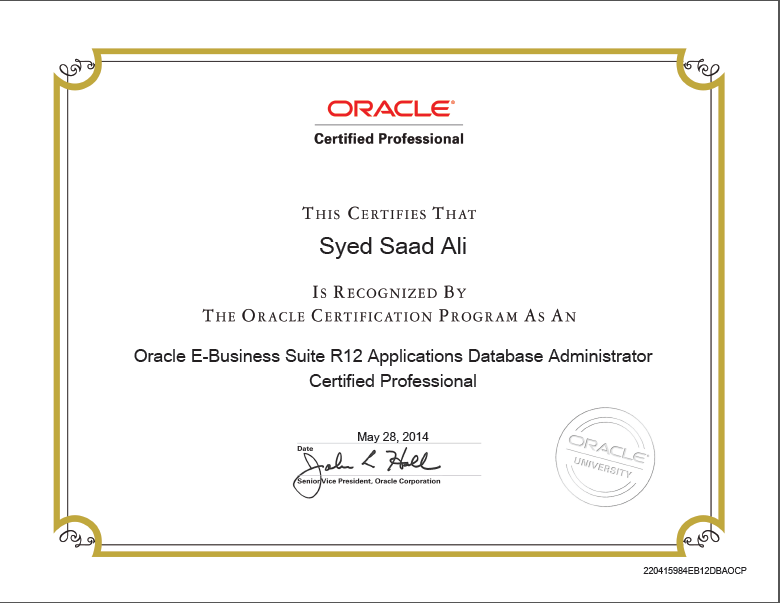
Oracle E-Business Suite R12 Applications Database Administrator Certified Professional 

Certificate
Skills
Oracle Expertise
  • Oracle Databases
  • Oracle E-Business Suite
  • Oracle Weblogic
  • Oracle Cloud Infrastructure
  • Oracle Database Appliances
Languages
  • English
System
  • Linux
    90%
  • Microsoft
    75%
  • SOLARIS
    65%
  • AIX
    60%
Knowledge
  • Installation/Configuration
  • Capacity Planning
  • Data Recovery Plan
  • Oracle Database Migration and Upgrade
  • Oracle ERP Migration and Upgrade
  • Linux and Windows management
  • Performance Evaluation

Blog

June 5, 2017 PL/Sql Interview Questions Part 2
Database Interview QuestionsInterview Questions

1. What is PL/SQL?

  • PL/SQL stands for procedural language extension to SQL.
  • It supports procedural features of programming language and SQL both.
  • It was developed by Oracle Corporation in early of 90’s to enhance the capabilities of SQL.

2. What is the purpose of using PL/SQL?

  • PL/SQL is an extension of SQL.
  • While SQL is non-procedural, PL/SQL is a procedural language designed by Oracle.
  • It is invented to overcome the limitations of SQL.


3. What are the most important characteristics of PL/SQL?

A list of some notable characteristics:

  • PL/SQL is a block-structured language.
  • It is portable to all environments that support Oracle.
  • PL/SQL is integrated with the Oracle data dictionary.
  • Stored procedures help better sharing of application.

4. What is PL/SQL table? Why it is used?

  • Objects of type tables are called PL/SQL tables that are modeled as database table.
  • We can also say that PL/SQL tables are a way to providing arrays.
  • Arrays are like temporary tables in memory that are processed very quickly.
  • PL/SQL tables are used to move bulk data.
  • They simplifies moving collections of data.


5. What are the datatypes available in PL/SQL?

There are two types of datatypes in PL/SQL:

  1. Scalar datatypes Example are NUMBER, VARCHAR2, DATE, CHAR, LONG, BOOLEAN etc.
  2. Composite datatypes Example are RECORD, TABLE etc.

6. What is the basic structure of PL/SQL?

PL/SQL uses BLOCK structure as its basic structure.

Each PL/SQL program consists of SQL and PL/SQL statement which form a PL/SQL block.

PL/SQL block contains 3 sections.

  1. The Declaration Section (optional)
  2. The Execution Section (mandatory)
  3. The Exception handling Section (optional)

8. What is exception? What are the types of exceptions?

Exception is an error handling part of PL/SQL.

There are two type of exceptions: pre_defined exception and user_defined exception.

9. How to write a single statement that concatenates the words ?Hello? and ?World? and assign it in a variable named Greeting?

Greeting := ‘Hello’ || ‘World’;

10. Does PL/SQL support CREATE command?

No, PL/SQL doesn’t support the data definition commands like CREATE.

11. Write a unique difference between a function and a stored procedure.

A function returns a value while a stored procedure doesn’t return a value.

12. How exception is different from error?

  • Whenever an Error occurs Exception arises.
  • Error is a bug whereas exception is a warning or error condition.


13. What is the main reason behind using an index?

By using an Index we can access data blocks Faster in the table.

14. What are PL/SQL exceptions? Tell me any three.

  1. Too_many_rows
  2. No_Data_Found
  3. Value_error
  4. Zero_error etc.

15. How do you declare a user-defined exception?

You can declare the User defined exceptions under the DECLARE section, with the keyword EXCEPTION.

Syntax:

<exception_name> EXCEPTION;


June 5, 2017 PL/Sql Interview Questions Part 1
Database Interview QuestionsInterview Questions


1. What are Procedure, functions and Packages?

  • Procedures and functions consist of set of PL/SQL statements that are grouped together as a unit to solve a specific problem or perform set of related tasks.
  • Procedures do not return values while Functions return one Value.
  • Packages provide a method of encapsulating and storing related procedures, functions, variables and other Package Contents


2.What is a ROWID and Why does it needed?

ROWID is the physical address (location) of the row on the disk. This is the fastest way to access a row in a table.


3.How many types of SQL Statements are there in Oracle?

There are  6 types of SQL statements.

Data Definition Language (DDL): The DDL statements define and maintain objects and drop objects.

Data Manipulation Language (DML): The DML statements manipulate database data.

Transaction Control Statements: Manage change by DML.

Session Control: Used to control the properties of current session enabling and disabling roles.

System Control Statements: Change Properties of Oracle Instance.

Embedded SQL: Incorporate DDL, DML and T.C.S in Programming Language.


4.How many Integrity Rules are there and what are they?

There are Three Integrity Rules as follows:

Entity Integrity Rule: The Entity Integrity Rule enforces that the Primary key cannot be Null.

Foreign Key Integrity Rule: The FKIR denotes that the relationship between the foreign key and the primary key has to be enforced. When there is data in Child Tables the Master tables cannot be deleted.

Business Integrity Rules: The Third Integrity rule is about the complex business processes which cannot be implemented by the above 2 rules.


5.How to implement the If statement in the Select Statement?

We can implement the if statement in the select statement by using the Decode statement.

e.g select DECODE (EMP_CAT,’1′,’First’,’2′,’Second’Null);

Here, the Null is the else statement where null is done .


6.How do you use the same LOV for 2 columns?

  • We can use the same LOV for 2 columns by passing the return values in global values and using the global values in the code.


7.What are snap shots and views?

  • Snapshots are mirror or replicas of tables.
  • Views are built using the columns from one or more tables.
  • The Single Table View can be updated but the view with multi table cannot be updated.


8.What is the difference between candidate key, unique key and primary key?

  • Candidate keys are the columns in the table that could be the primary keys and the primary key is the key that has been selected to identify the rows.
  • Unique key is also useful for identifying the distinct rows in the table.


9.What is Row Chaining?

  • The data of a row in a table may not be able to fit the same data block.
  • Data for row is stored in a chain of data blocks.


10.What is the difference between deleting and truncating of tables?

  • Deleting a table will not remove the rows from the table but entry is there in the database dictionary and it can be retrieved.
  • While truncating a table deletes it completely and it cannot be retrieved.


11.What is the Difference between a post query and a pre query?

  • A post query will fire for every row that is fetched but the pre query will fire only once.


12.How to Delete the Duplicate rows in the table?

We can delete the duplicate rows in the table by using the Rowid

Example: DELETE FROM table_name a  Where rowid>(select min(rowid) from table_name b where a.table_no=b.table_no);

13.Can we disable database trigger? How?

Yes we can disable database triggers through following issuing statement

ALTER TABLE TABLE [DISABLE all_trigger ]


14.Is space acquired in blocks or extents?

  • Space is acquired in extents.


June 3, 2017 Can EBS Nodes Be at Different Operating System Levels?
NEWS AND UPDATES

Can EBS Nodes Be at Different Operating System Levels?

By: Steven Chan | Senior Director

Oddly, a category of EBS architecture questions that I’d thought long-settled is starting to reemerge.  I’ve recently seen several queries along the lines of:

  1. Can EBS database nodes and application tier nodes be on different operating systems?
  2. Can multiple EBS database nodes be on different operating systems or levels?
  3. Can multiple EBS application tier nodes be on different operating systems or levels?

Here are the answers to these questions:

1. Can EBS database nodes and application tier nodes be on different operating systems?

Yes.  In some cases, the operating systems certified for EBS database nodes cannot be run on the application tier. These are called “database tier only” certifications. It is quite common to see this configuration, especially in large EBS environments.

2. Can multiple EBS database nodes be on different operating systems or levels?

No.  From our “Installation Guide: Using Rapid Install” documentation:

“All database tier nodes must be at the same operating system patch level.”

3. Can multiple EBS application tier nodes be on different operating systems or levels?

No. From our “Installation Guide: Using Rapid Install” documentation:

“All application tier nodes must be at the same operating system patch level.”

Here’s a screenshot from our EBS 12.2 documentation (emphasis in red):

References

Related Articles

Source: https://blogs.oracle.com/stevenchan/can-ebs-nodes-be-at-different-operating-system-levels

June 3, 2017 Webcast: “Managing Oracle E-Business Suite Auditing and Security”
NEWS AND UPDATES

Webcast: “Managing Oracle E-Business Suite Auditing and Security”

By: Steven Chan | Senior Director

Oracle University has a large number of free recorded webcasts for Oracle E-Business Suite.  One of the essential webcasts on security that all EBS sysadmins should review is:

Eric Bing, Senior Director Product Development and Elke Phelps, Senior Principal Product Manager share recommendations for auditing, monitoring and securing your Oracle E-Business Suite environment and sensitive data.  Configuration guidelines for monitoring and auditing activity in your Oracle E-Business Suite application and database will be provided.  The session will provide an overview of our secure configuration guidelines, updates to the secure configuration scripts, and optional security integrations. Also shared is a summary of some of the new security features available in Oracle E-Business Suite 12.2 including enhancements for proxy user functionality and how to reduce your attack surface by reducing cookie scope, allowed JavaServer Pages (JSPs), and external redirects. This material was presented at OOW 2015.

Related Articles

Source:https://blogs.oracle.com/stevenchan/webcast%3a-managing-oracle-e-business-suite-auditing-and-security


June 3, 2017 Enabling an EBS Global Diagnostics Trace
NEWS AND UPDATES

Enabling an EBS Global Diagnostics Trace

By: Steven Chan | Senior Director

Oracle E-Business Suite provides several types of logs.  One of the tools you can use is the Logging Framework, which allows you to collect and view log messages in Oracle Applications Manager.  The Logging Framework collects debug messages, errors, and alerts.

A Global Diagnostics Trace can help you diagnose issues if errors occur when users click a button or select an option. It’s a targeted trace that can be run per user, thereby minimizing the impact on the overall performance of your environment. This kind of trace is also known as an FND Diagnostics Trace or Oracle Applications Logging.

You can find a quick summary of steps to enable a Global Diagnostics trace here:

There’s lots more information about more-powerful logging options in the following manuals:

Related Articles

Source: https://blogs.oracle.com/stevenchan/enabling-an-ebs-global-diagnostics-trace


June 3, 2017 Webcast: “E-Business Suite 12.2 Upgrade Best Practices to Minimize Downtime”
NEWS AND UPDATES

Webcast: “E-Business Suite 12.2 Upgrade Best Practices to Minimize Downtime”

By: Steven Chan| Senior Director

Oracle University has a large selection of free recorded webcasts for Oracle E-Business Suite.  If you’re planning to upgrade to EBS 12.2, the following webcast is worth your time:

This session is ideal for organizations thinking about upgrading to Oracle E-Business Suite 12.2. Samer Barakat, Director Application Performance, covers best practices and performance optimizations to minimize 12.2 upgrade downtime. This material was presented at Oracle OpenWorld 2015.

Related Articles

Source: https://blogs.oracle.com/stevenchan/webcast%3a-e-business-suite-122-upgrade-best-practices-to-minimize-downtime


Contact

Get in Touch
  • Address: Karachi, PAKISTAN
  • Email: askme@SyedSaadAli.com
  • Phone: +92-300-026-5668
  • Freelance: Available
Contact Form